
Hot Foil Printing on Plastic Components
Durable, high-impact foil finishes applied to moulded plastic components — ideal for branding, legends and premium detailing where wear resistance and a consistent finish are critical.
Best for
- Flat surfaces, raised features, metallic, mirror or luxury finishes
- Smooth, coated, and finished plastic components
- High volume runs and repeat production volumes
- Functional markings, legends, and durable branding
B2B manufacturing work only. If you have a consumer/personal project, please contact us first to confirm suitability.

Heat-bonded prints that resist wear, handling, and abrasion
Metallic, gloss and solid foils with sharp definition
Best suited for flat plastics, coatings and raised features
Reliable turnaround and responsive technical support
What is hot foil printing?
Hot foil printing (also known as hot foil blocking) uses heat and pressure to transfer a foil layer onto a component via a precision die or silicone sheet. The process produces crisp, durable markings with a distinctive visual finish.
Unlike ink-based printing, the foil is physically bonded to the surface, making it particularly suitable for applications requiring abrasion resistance, consistent appearance, and long-term durability.
Where hot foil printing works best
- Components with defined flat or raised areas
- Printing areas which can be supported firmly underneath
- Logos and legends requiring metallic or gloss finishes
- Applications where wear resistance is critical
Hot foiling in practice
A short process clip showing hot foil transfer on a moulded plastic component.
Bezel hot foiling
Demonstrates repeatable foil transfer using heat, pressure and a flat die to decorate raised features.
If you only have a sample part, send a photo and we’ll advise on foil choice, die approach, and expected results.
Is your component suitable for hot foiling?
Hot foil printing relies on controlled pressure and precise contact between the die and the component surface. Certain part features can limit suitability or require process adjustments.
The most common factors that determine whether hot foiling will produce consistent, repeatable results.
Flatness of the print area
Best on flat or gently contoured surfaces. Flow lines, sink marks, or undulation can prevent full transfer or require higher pressure, reducing definition elsewhere.
Moulding quality and surface consistency
Variations in wall thickness can lead to uneven pressure and inconsistent results.
Gate / sprue position
If the sprue is within or close to the print area, trimmed thickness can vary part-to-part, affecting repeatability and registration.
Raised and recessed features
Raised text/logos are often ideal if they stand at least 0.5mm proud. Printing raised features using a flat silicone die that contacts only the raised areas is known as tipping. Hot foiling into recessed features is generally not recommended due to creasing and poor definition.
Material and finish
Plastic type, coatings, and texture influence foil adhesion and may require specific foil grades or die materials.
If you’re unsure, a photo or sample is often enough for us to advise on print area suitability, die type (metal or silicone), pressure limits, and expected results.
Quick suitability check
- Flat or raised print area with firm support
- Smooth or coated surface finish
- Repeat production or stable artwork
If any of these are uncertain, a photo or sample is usually enough for us to advise.
What we print
Hot foil printing is often specified where visual impact and durability are equally important — particularly in commercial, automotive, and industrial products.
We’ll advise early if hot foil printing is not the most suitable process for a particular component.
Plastic mouldings (core)
Injection-moulded and formed components for industrial and commercial products. Suitable for flat faces, raised areas, and tight registration requirements.
Surface finishes & coatings
Painted, lacquered, coated, and hard surface finishes where ink-based printing may not provide sufficient adhesion or longevity. We can advise on foil selection and process suitability.
Additional substrates
Selected materials where surface condition, flatness, and end-use requirements are appropriate for hot foil transfer.
Materials & foil finishes
We regularly hot foil print onto injection-moulded and formed plastic components, with material suitability assessed on a case-by-case basis.
- ABS, PC, acrylic, and blended plastics
- Bare, Painted, or coated surfaces
- Metallic, gloss, matte, and specialist foils
- Selected non-plastic substrates where appropriate
Surface finish, geometry, and end-use requirements all influence foil and process selection. We’ll advise during quotation if hot foil printing is suitable for your component.

Artwork, dies & jigs
As part of our hot foil printing service, we can support:
- Artwork preparation and verification
- Metal and silicone die design
- Jig and fixture manufacturing for accurate repeatability
If you already have artwork or tooling in place, we’ll work with what you have. If not, we can manage the process as part of your job.
Hot foil printing vs pad printing
While both processes are used for marking plastic components, each has strengths depending on the application.
- Hot foil printing: metallic or high-gloss finishes, raised features, high wear resistance
- Pad printing: complex geometry, multiple colours, fine detail
Many customers use both processes across different parts. We’re happy to advise on the most appropriate method during quotation.
Hot foiled examples
A selection of hot foiled components and products produced for customers across industrial and commercial applications.

Flat plastic components
Permanent markings on injection-moulded plastics with flat or raised faces. Ideal for logos, text, and functional graphics.
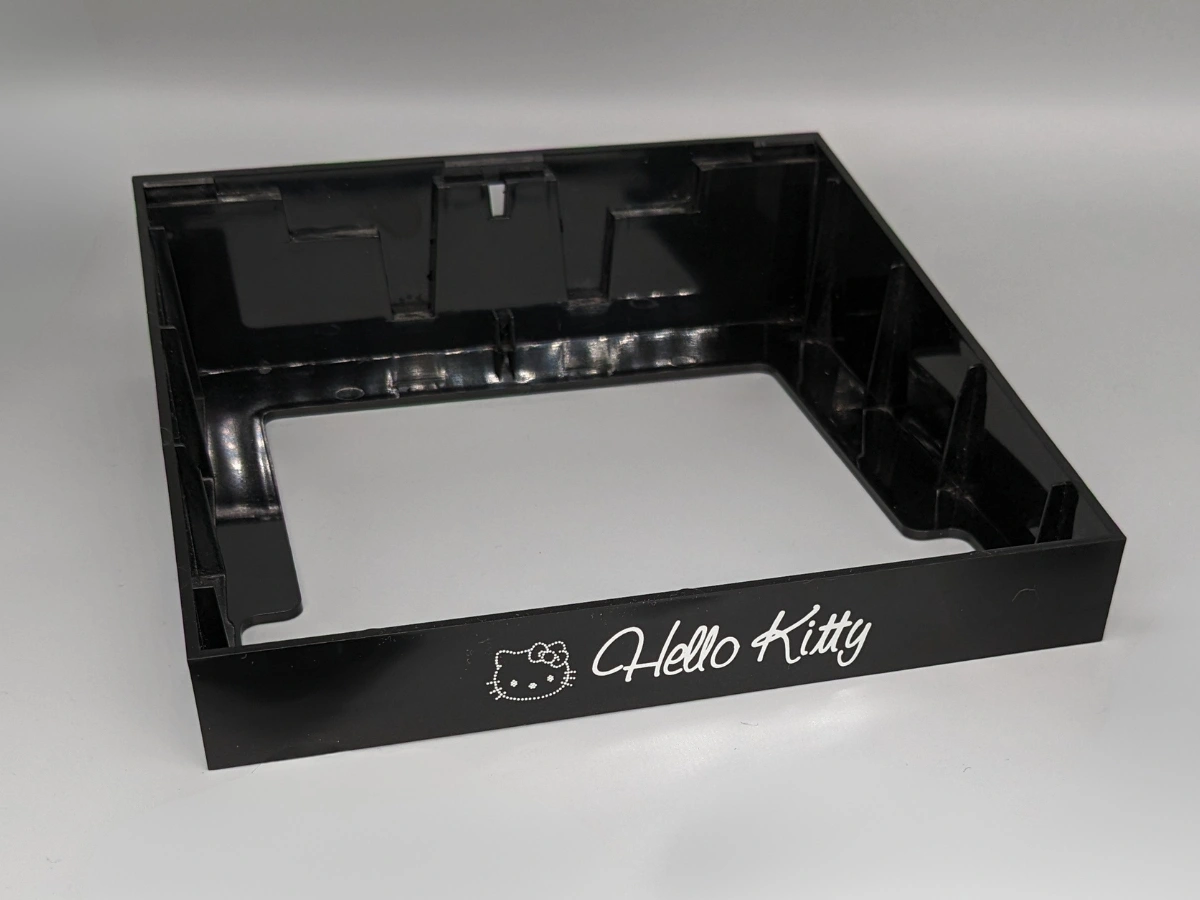
Premium branding & detailing
High-definition solid and metallic foils used to create clean, professional branding with excellent wear resistance.

Durable industrial applications
Consistent results on parts exposed to handling, abrasion, and demanding end-use environments.
Hot foiling FAQ
Can you hot foil on curved or recessed parts?
Foil printing is particularly suitable for smooth, flat and raised surfaces. Light contours can sometimes be accommodated, but deep curves, recesses, or heavy textures are usually better suited to pad printing. Curved dies and fixtures can be sourced for special applications, but they tend to be expensive with long lead times.
Can you match colours?
Foils are available in many standard colours. Specific colour-matched foils have to be manufactured. The minimum production quantities are very large, so only really viable for high volume orders.
How durable is hot foil printing?
Hot foil printing produces heat-bonded markings that are highly resistant to wear, handling, and abrasion. It is often chosen where ink-based printing does not offer sufficient longevity.
What do you need to provide a quote?
To provide an accurate quote, we typically require component drawings or samples, artwork, material specification, quantity, and details of the end-use environment.
Is hot foil printing suitable for small quantities?
Hot foil printing involves tooling, so it is generally most cost-effective for medium to high production volumes. For lower quantities or frequently changing artwork, alternative processes may be more suitable.
Request a quote for hot foil printing
If you have a component that requires durable foil branding or markings, send us the details and we’ll confirm suitability, process, and pricing.